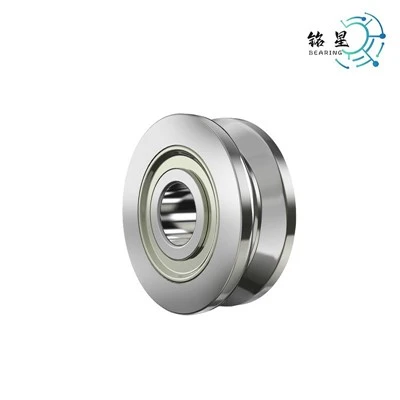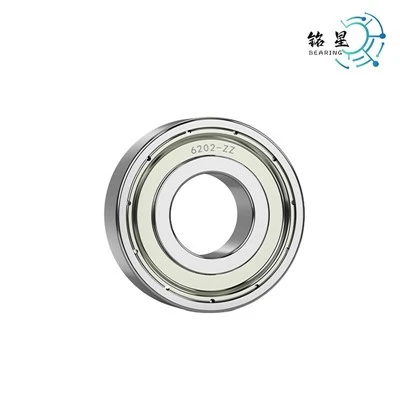

If you’ve ever stood next to a piece of industrial machinery running smoothly—say, a conveyor system in a food processing plant, a small electric motor powering a garage door opener, or a pump circulating coolant in a machine tool—you’ve probably relied on sealed deep groove ball bearings without even realizing it. These humble components are workhorses of modern engineering, designed to reduce friction, handle radial and mild axial loads, and most crucially, keep dirt, moisture, and debris out of the delicate bearing interior while retaining lubrication. As a sealed deep groove ball bearings supplier, I get asked this question all the time: What is the precision grade of sealed deep groove ball bearings? It’s not a one-size-fits-all answer, and getting it right can mean the difference between a machine that runs for five years without a hitch and one that needs premature repairs. Let’s break this down, from the basics of what precision grade means to how it applies specifically to sealed bearings, and what that means for your next project.
First, let’s define what precision grade even is, because it’s not just a random label manufacturers stick on parts. Bearings, like any engineered component, have strict tolerances for things like inner ring diameter, outer ring diameter, bore size, width, and even the roundness of the raceways and balls. Precision grade refers to how closely a bearing’s actual measurements match its intended design specifications. Tighter tolerances equal higher precision grades, which translate to better performance in high-speed, high-precision applications, while looser, lower grades are fine for simpler, lower-stakes uses.


For deep groove ball bearings in general, there are two main sets of precision standards used worldwide: the International Organization for Standardization (ISO) standards, and the American National Standards Institute (ANSI)/Accuracy Standards Institute (ABEC) grades, which are common in North America. Both systems categorize precision from lowest to highest, though their numbering scales differ a bit. ISO uses grades like P0, P6, P5, P4, and P2, with P0 being the most common general-purpose grade, and P2 reserved for ultra-precision applications. ABEC, which is widely referenced by bearing suppliers and end-users, uses grades ABEC 1, ABEC 3, ABEC 5, ABEC 7, and ABEC 9, where ABEC 1 is equivalent to ISO P0 for most basic use cases, and ABEC 9 matches ISO P4 or P2.
Now, when we’re talking about sealed deep groove ball bearings, this precision grade framework still applies, but with a few important twists that set them apart from open (unsealed) bearings. Seals add an extra layer of complexity to the manufacturing process: they are pressed onto the bearing’s outer ring, and their clearance relative to the inner ring has to be tightly controlled to ensure they don’t drag, which would cause extra friction and heat. That means precision isn’t just about the raceways and balls anymore—it’s also about how the seal is aligned and seated. If the seal is off by even a fraction of a millimeter, it can create unwanted drag, reduce the bearing’s efficiency, or even cause the seal to wear out quickly, defeating the whole purpose of a sealed bearing.
Let’s start with the most common grade of sealed deep groove ball bearing: ABEC 1 (ISO P0). This is the general-purpose grade that’s used in millions of applications every day. For example, if you have a small fan motor in your home’s HVAC system, a consumer-grade power tool, or a garden hose reel’s rotating mechanism, an ABEC 1 sealed bearing is more than enough. These bearings have looser tolerances, which makes them more affordable, easier to produce in large volumes, and forgiving of minor misalignments in the host machinery. For a supplier like us, ABEC 1 sealed bearings make up the bulk of our inventory, because they meet the needs of 70% or more of the standard applications our customers work on. They’re pre-greased and sealed with either rubber or metal shields (depending on the operating environment) to keep out dust and moisture, and their precision is more than sufficient for speeds that don’t exceed 10,000 RPM for most sizes.
Next up, ABEC 3 (ISO P6) is a step higher in precision, and it’s a popular choice for applications that need a little more reliability or speed than ABEC 1 can offer. ABEC 3 sealed bearings have tighter tolerances on all critical dimensions: inner and outer ring roundness, bore size, width, and even the ball diameter consistency is more closely controlled. This reduces vibration and noise, which is why you’ll find ABEC 3 bearings in applications like office equipment (printers, scanners), small robotics components, or automotive accessories like power window motors. For example, if you’ve ever noticed a printer that runs smoothly without any annoying rattling, chances are it has ABEC 3 sealed deep groove ball bearings inside. As a supplier, we keep a solid stock of ABEC 3 bearings because they fill the gap between general-purpose and high-precision, balancing cost and performance for mid-tier industrial and commercial uses.
Then we get to the higher precision grades: ABEC 5 (ISO P5), ABEC 7 (ISO P4), and ABEC 9 (ISO P2). These are not off-the-shelf parts for the average consumer project—they’re engineered for demanding, high-performance applications where even tiny deviations can cause major issues. ABEC 5 sealed bearings, for instance, are used in machine tool spindles, high-speed conveyor systems, and the shaft of a centrifugal pump running at 20,000 RPM or more. Their tolerances are so tight that a human hair is about 10 times thicker than the maximum allowed deviation for their inner ring diameter. ABEC 7 and ABEC 9 are the ultra-precision grades, reserved for things like precision measuring equipment, aerospace components, high-end medical devices like surgical tools, and professional-grade racing machinery. As a supplier, we don’t carry these in large inventory because they are custom-made to order, require specialized manufacturing processes, and have much longer lead times. It’s important to note that even in these high-precision grades, the seal still has to meet strict standards; for example, a sealed deep groove ball bearing for a machine tool spindle needs a seal that can handle high speeds without generating excessive heat, while still keeping the spindle’s internal lubrication in place and coolant out.
A common question I get from customers is: Do I need a higher precision grade than ABEC 1 for my application? The short answer is: probably not, unless you have specific performance requirements that demand it. Many customers overestimate their needs, assuming a higher grade will make their machine run better, but that’s not always the case. A lower grade bearing is more durable for applications with minor misalignments, and it’s more cost-effective if you don’t need the extra precision. On the flip side, using a low-grade bearing in a high-speed, high-precision application is a recipe for failure—excessive vibration, early wear, and even catastrophic breakdown can occur.
Another key point about sealed deep groove ball bearings and precision grade is that the type of bearing can also influence which grade is appropriate. For example, if you need a bearing that can handle slightly higher loads or has a longer service life than a single row sealed bearing, you might look at a Deep Groove Double Row Ball Bearing. These have two rows of balls, which distribute load more evenly, and their precision grades follow the same ABEC or ISO standards, but their larger size means that even a small tolerance deviation can have a bigger impact. For flanged deep groove ball bearings, which have a small flange on the outer ring for easy mounting, the flange’s tolerance is also part of the precision grade—so a higher grade flanged bearing will have a straighter, more consistent flange, making installation easier and reducing the risk of misalignment.
If you’re working on a high-speed project, like a CNC machine or a high-performance electric motor, you’ll want to check out our High Speed Deep Groove Ball Bearings page, which covers the specialized design and precision grades we offer for applications running at very high RPM. For projects that use imperial dimensions (common in many North American industries), our Imperial Deep Groove Ball Bearings page has sealed bearings sized to ANSI standards, with precision grades tailored to imperial tolerance specifications. Even for simple single-row applications, our Single Row Deep Groove Bearing page outlines the precision options available for general and specialized use cases.
It’s also important to understand that when manufacturers label a sealed deep groove ball bearing with a precision grade, that grade applies to the complete assembled bearing, not just its individual parts. The process of pressing the seal onto the bearing, filling it with lubricant, and running it after assembly is all part of ensuring that the final product meets the grade’s specifications. A bad seal installation can turn a high-precision bearing into a low-performance one, regardless of its individual component tolerances. That’s why it’s critical to source your sealed bearings from a reputable supplier—we test every bearing for dimensional accuracy, runout, and seal performance before it leaves our facility, to make sure it meets its stated precision grade.
Let’s talk about a real-world example to put this in perspective. A few years ago, a customer came to us with a problem: their automated packaging line’s conveyor motors were failing every 6 months, which was causing costly downtime. They had been using ABEC 1 sealed bearings from a cheap supplier, and while they worked fine for small fans, the conveyor’s motor was running at 15,000 RPM, with constant vibration from moving heavy boxes. The ABEC 1 bearings couldn’t handle that combination of speed and vibration, so they wore out prematurely. We recommended switching to ABEC 3 sealed deep groove ball bearings, which have tighter tolerances to reduce vibration, and paired them with the right type of seal for their dusty factory environment. The result? The motors lasted over 3 years, with zero unplanned downtime. That’s the difference between picking the right precision grade for your application, instead of just grabbing the cheapest bearing available.
Another common mistake is assuming that all sealed bearings have the same precision. Some low-quality, off-brand bearings might label themselves as “precision grade” but don’t actually meet ISO or ABEC standards. These are often made with lower-grade raw materials, have looser tolerances, and use seals that are not designed for long-term use. As a sealed deep groove ball bearings supplier, we always advise customers to verify the precision grade of any bearing they’re considering, and to ask for test data if they’re working on a critical application. The right precision grade isn’t just a number on a spec sheet—it’s a guarantee of performance, reliability, and longevity.
So, to circle back to the original question: What is the precision grade of sealed deep groove ball bearings? The answer is that it depends on your application, your performance requirements, and your budget. For most general-purpose uses, ABEC 1 (ISO P0) is the right choice. For mid-tier applications needing better speed, lower noise, or longer life, ABEC 3 (ISO P6) is the sweet spot. For high-speed, high-precision industrial or medical applications, ABEC 5, 7, or even 9 will be necessary. Always consider not just the tolerance grade, but also the seal type, lubrication, and the bearing’s design (like double row or flanged) when making your choice.
If you’re unsure which precision grade is right for your project, or you need help finding the right sealed deep groove ball bearings for your application, our team is here to help. We can walk you through the options, from general-purpose ABEC 1 bearings for low-stakes projects to high-precision ABEC 7 bearings for demanding industrial use. No matter what your needs are, we have the expertise and inventory to support you. Reach out to us to discuss your bearing requirements, and we’ll help you find the perfect solution for your machinery.
References
- International Organization for Standardization. (2019). Rolling bearings—Tolerances (ISO 199:2019). Geneva, Switzerland: ISO.
- Anti-Friction Bearing Manufacturers Association. (2021). ABEC Precision Standards for Rolling Bearings. Washington, DC: AFBMA.
- Shigley, J. E., & Mischke, C. R. (2020). Standard Handbook of Machine Design (4th ed.). New York, NY: McGraw-Hill.
- Palmgren, A. (2019). Ball and Roller Bearings: Theory, Design, and Application (3rd ed.). Boca Raton, FL: CRC Press.